Build high velocity Taxi Teams
In my previous post on the AI-Driven Development Lifecycle(AI-DLC) fundamentals, I outlined how AI-DLC bridges the gap between fully AI-Managed approaches that sacrifice human control and traditional AI-Assisted approaches that slow development velocity. Now, let’s explore the practical implementation — how small cohesive teams structure themselves and operate within the AI-DLC methodology.
This post serves as your practical implementation guide for the people structure and collaborative practices that make AI-DLC effective. The transformation required isn’t just about adopting new tools—it’s about fundamentally restructuring how teams collaborate, make decisions, and leverage AI as a true development partner.
The Small Cohesive Team Structure Link to heading
Core Team Composition Link to heading
AI-DLC operates most effectively with small, cross-functional teams where each role has clear ownership and accountability. Team size must remain minimal—each additional member introduces communication overhead that slows decision-making and reduces AI-DLC’s velocity benefits. As a practical guideline, the cross-functional team should fit comfortably in a taxi (typically 4-6 people)—I call this a “Taxi Team.” The optimal team size includes only the essential expertise needed to effectively guide AI suggestions and validate outputs across all phases.
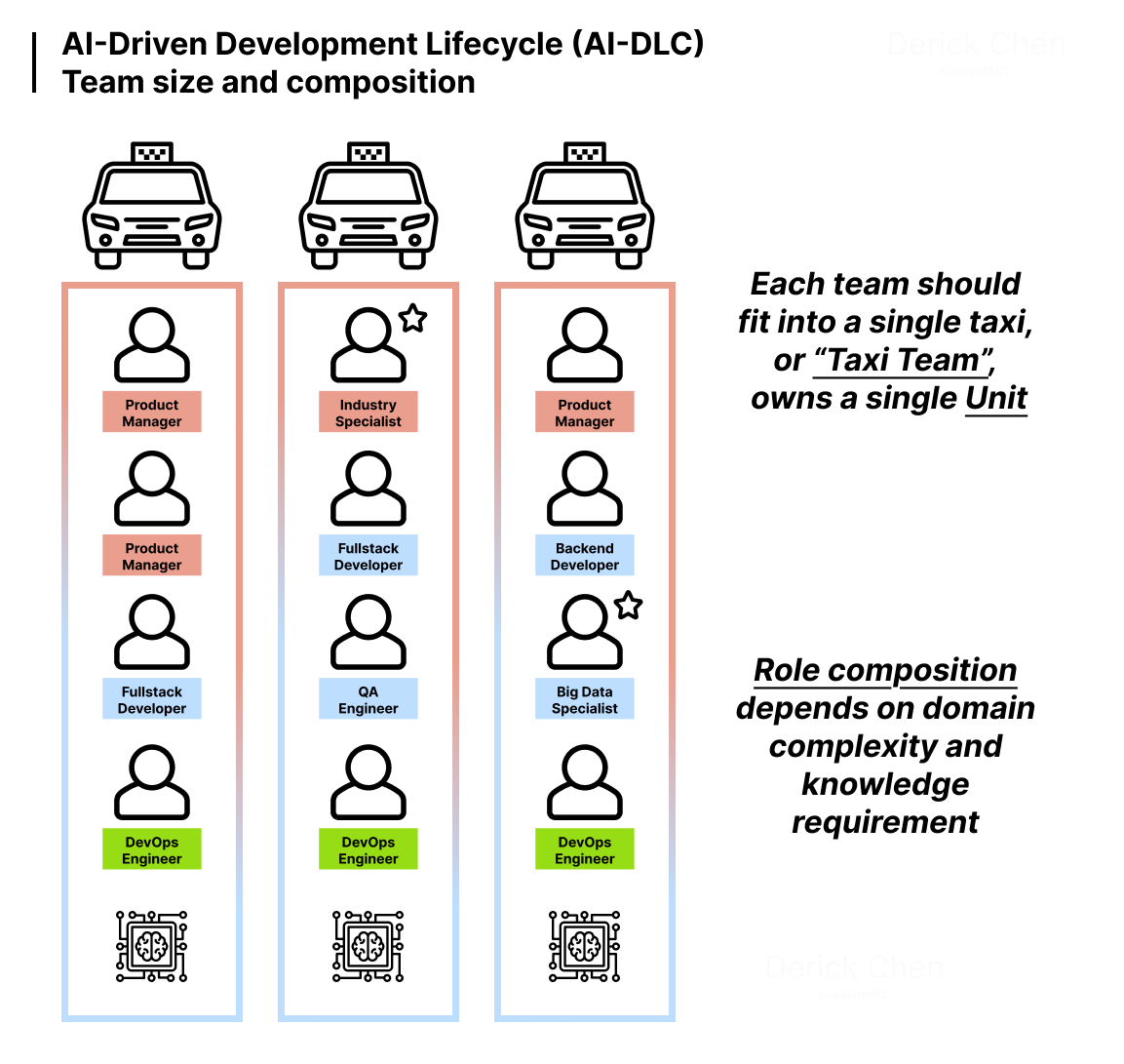
The Taxi Team analogy perfectly captures the AI-DLC dynamic. Like passengers sharing a taxi, the entire team moves together toward the same destination—defining business outcomes based on customer needs. Just as a taxi has limited seats, the team must stay small to avoid overcrowding and conflicting directions. The AI agent serves as the skilled driver, handling the complex navigation and execution to get there efficiently. But unlike traditional taxi rides, backseat driving isn’t just welcome—it’s essential. The team continuously guides, corrects, and validates the AI’s route, ensuring we all arrive at exactly the right destination through the optimal path.
The number of roles for each Taxi Team depends on the domain complexity. If a project has simple technical implementation but complex business logic and policies, then this team should have more BA roles. Conversely, technically complex projects with straightforward business requirements should emphasise technical roles.
Business Analyst/Product Owner/Product Manager: Leads and owns Mob-Elaboration ceremonies during the Inception phase, driving requirements analysis and business context definition.
Solutions Architect/Software Engineer/DevOps Engineer: Leads and owns Mob-Programming ceremonies during the Construction phase, guiding architectural decisions and technical implementation strategy.
QA Engineer: Leads and owns Mob-Testing ceremonies across all phases, ensuring quality validation and comprehensive testing coverage.
Supporting Team Members: Domain-specific specialists join as needed to apply specialised expertise. For example, a Big Data specialist might participate during the Construction phase of a data analytics project.
Role Ownership by Phase Link to heading
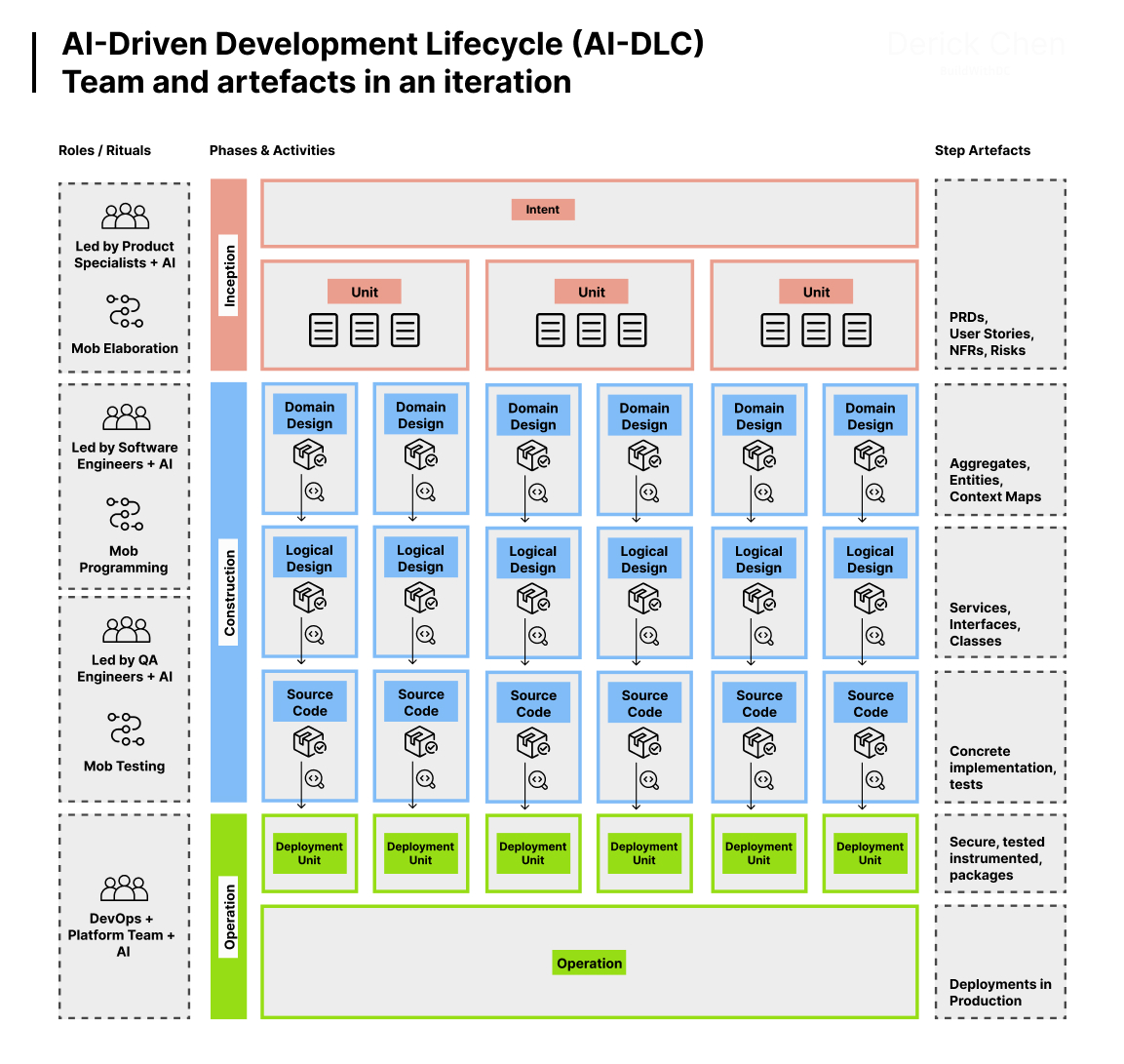 Inception Phase: The Business Analyst/PO/PM drives Mob-Elaboration with full team collaboration, owning key decisions on business requirements and user story definition.
Construction Phase: The Solutions Architect/Software Engineer/DevOps Engineer drives Mob-Programming with team collaboration, owning key technical design decisions while developers focus on implementation details once strategic and tactical design is agreed upon.
Operation Phase: Platform teams support the operation of project team DevOps engineers in a “you-build-you-run” model, maintaining operational responsibility.
Cross-Phase: The QA Engineer leads Mob-Testing activities throughout all phases, ensuring continuous quality validation and testing alignment.
The Mob Ceremony Approach Link to heading
AI-DLC fundamentally changes how teams work together through “mob activities”—a key departure from traditional individual task assignments. Taking inspiration from pair programming, we extend this collaborative approach one step further: the entire Taxi Team participates together in every critical step of the development process.
Unlike traditional workflows where team members work in isolation on separate tasks and integrate their work later, mob activities ensure continuous alignment and shared understanding. Every team member contributes their expertise in real-time while AI generates artefacts, creating immediate feedback loops and eliminating the costly rework that comes from misaligned individual efforts.
This approach maximises the value of both human expertise and AI capabilities—humans provide strategic guidance, domain knowledge, and validation while AI handles the routine artefact creation. The result is higher quality outputs with faster iteration cycles and complete team alignment on every decision.
Mob Ceremony Practices Link to heading
Mob-Elaboration (Inception Phase) Link to heading
Led and owned by: Business Analyst/PO/PM Participants: Full cohesive team AI Role: Suggests solutions for requirements analysis and quickly creates user stories, acceptance criteria, and decision documents AI-DLC Actions: Team uses Plan-Execute-Validate cycle. AI suggests approaches during Planning, creates artefacts during Execution, and the team validates outputs Outcomes: User stories, acceptance criteria, technical specifications Duration/Frequency: 2 hours, once per iteration
During Mob-Elaboration, the BA/PO/PM guides the team through collaborative requirements analysis. AI serves as an active participant, suggesting requirement solutions and generating user stories in real-time while the team applies human insights and business context validation.
Mob-Programming (Construction Phase) Link to heading
Led and owned by: Tech Lead Participants: Full cohesive team AI Role: Suggests architectural solutions and quickly generates implementation code, tests, and technical documentation AI-DLC Actions: Team uses Plan-Execute-Validate cycle. AI suggests design approaches during Planning, generates code during Execution, team validates implementation. Developers focus on lower-level implementation once the team agrees on strategic and tactical design Outcomes: Architectural decisions, technical artefacts, implementation code Validation: Real-time code review and quality checks
The Tech Lead directs AI to suggest architectural solutions and generate code during live programming sessions while ensuring adherence to organisational best practices. The team maintains strategic oversight while AI handles routine implementation tasks.
Mob-Testing (Construction Phase) Link to heading
Led and owned by: QA Engineer Participants: Full cohesive team AI Role: Suggests testing strategies and quickly creates test cases, validation scripts, and quality reports AI-DLC Actions: Team uses Plan-Execute-Validate cycle. AI suggests test approaches during Planning, generates tests during Execution, team validates quality outcomes. Creates test plans from Inception phase business requirement artefacts, combined with technical design documents to develop test scripts Outcomes: Higher-level test cases (focus on integration and end-to-end), validation results, quality metrics Validation: Validate test plan with product roles and test scripts with software engineers
The QA Engineer leverages AI to suggest testing approaches and create comprehensive test cases based on key performance metrics and user behaviours, ensuring quality validation throughout the development process.
Human-AI Collaboration in Mob Ceremonies Link to heading
Collaboration Patterns by Ceremony Link to heading
Mob-Elaboration: BA/PO/PM guides AI to suggest requirement solutions and create user stories, acceptance criteria, and specification documents in real-time while applying human insights and feedback according to specific business context.
Mob-Programming: Tech Lead directs AI to suggest architectural solutions and generate code, tests, and documentation during live programming sessions while following organisational best practices.
Mob-Testing: QA Engineer leverages AI to suggest testing approaches and create test cases, validation scripts, and quality reports based on key performance metrics and user behaviours.
Plan-Execute-Validate in Mob Context Link to heading
Planning: Ceremony leaders collaborate with AI to elaborate objectives into detailed specifications. AI suggests optimal approaches and identifies challenges while the team reviews the plan together and clarifies points of ambiguity.
Execution: AI handles routine artefact creation according to the approved plan while the team focuses on strategic decisions and trade-offs.
Validation: Teams conduct immediate review and validation of AI-generated artefacts to ensure quality and alignment with requirements. Once validated, the team immediately creates documentation for the decisions and checks all artefacts into the repository.
Knowledge Transfer Between Ceremonies Link to heading
Artefact Flow: From the Inception phase, product requirement documents in the form of user stories or PRDs serve as context reference at the beginning of the Construction phase. During Construction, we turn business product requirements into domain design and use that as the input for logical design. Domain model and logical design capture all details from the product requirements and are sufficient as references for the code generation, providing the starting point for both mob-programming and mob-testing.
Documentation Practices: All documentation must be reviewed together by the team to ensure shared understanding and alignment across ceremonies. Documentation is also checked into the codebase to be updated and referenced for future iterations, helping to prevent deviation between docs and code that creates conflicting realities.
Next Steps Link to heading
Understanding the team structure and practices is only the beginning. The real challenge lies in transforming existing development organisations to adopt these new ways of working. In my next post, I’ll dive into the practical implementation strategy: how to transition existing teams to the AI-DLC model, manage organisational resistance, select the right pilot projects, and scale these practices across your development organisation.
The transformation requires more than new processes—it demands a fundamental shift in how we think about human-AI collaboration in software development.