Hear it from the programme leader
As a programme leader of the AI-Driven Development Lifecycle (AI-DLC) and early contributor to its foundational white paper, I lead this AWS programme in ASEAN and support the wider APJ region. I’m developing a series of learning resources to make AI-DLC principles and practices more accessible to development teams worldwide. This blog post explores the specific collaborative processes and team structure of AI-DLC.
Problem Statement Link to heading
Modern development teams face a critical dilemma: fully AI-managed approaches sacrifice human control and strategic oversight, while traditional AI-assisted approaches slow development velocity by requiring constant human supervision and guidance for routine tasks. AI-DLC bridges this gap by establishing a balanced framework that grants AI sufficient autonomy to execute implementation tasks efficiently while preserving essential human control over strategic decisions and quality validation.
Read more about the challenges that AI-DLC addresses in my other post → The AI-Driven Approach and Your code base isn’t ready for AI
Methodology Link to heading
AI-DLC breaks traditional Software Development Lifecycle (SDLC) into just 3 phases: Inception, Construction, and Operation. Each phase contains multiple steps that leverage AI capabilities while maintaining human oversight and strategic control. This enables an incremental complexity decomposition to reduce ambiguity for tasks in each step. The artefacts produced at each stage encapsulate the trade-off decisions made, are kept in the code base and are used as the input reference for the following step.
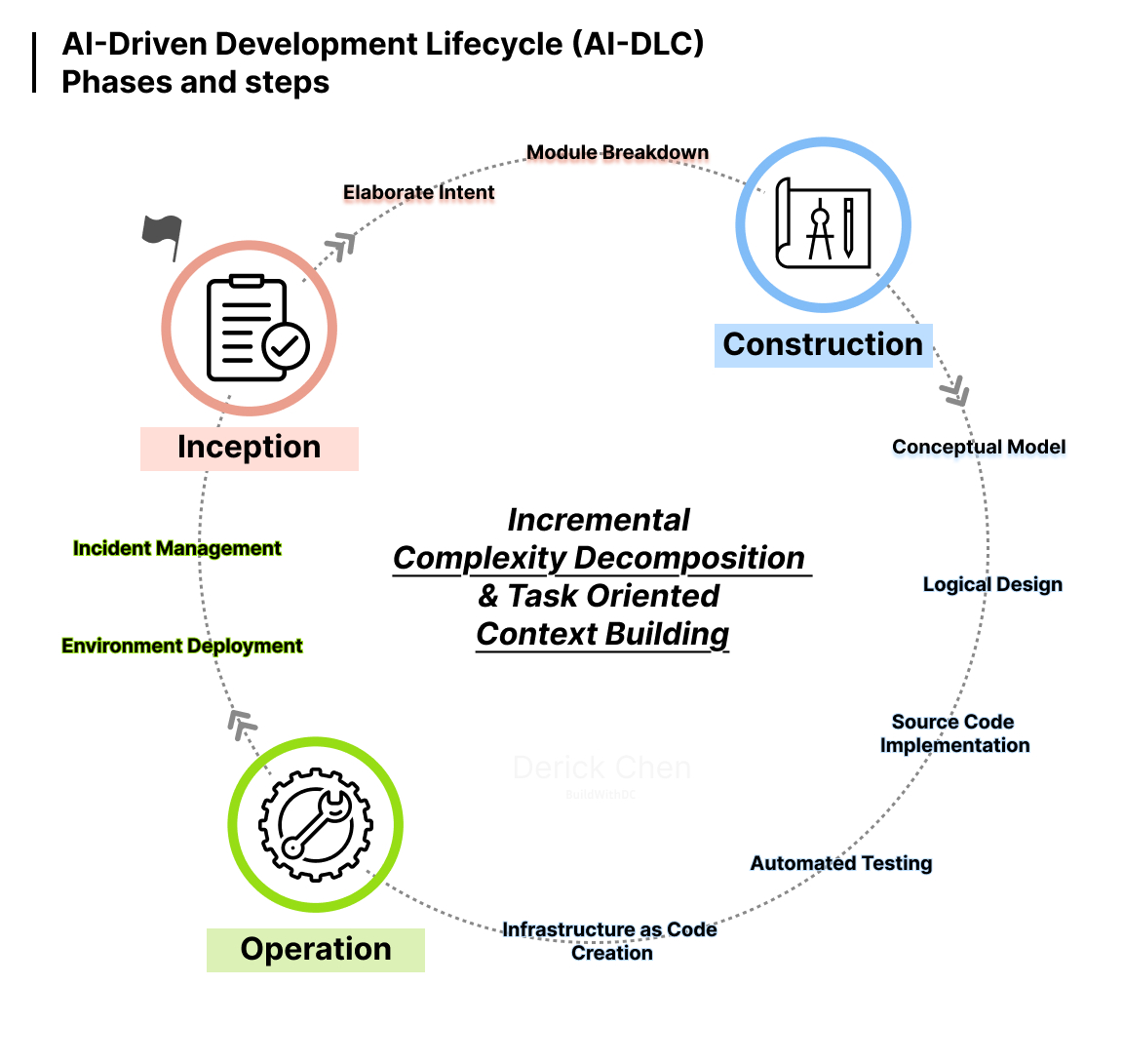 The decomposition of steps in each phase may feel familiar as we referenced the benefits of both Big Design Upfront and Scrum to achieved a balanced and AI-native process. I will explain in greater detail in a future post of how AI-DLC differs fundamentally from our traditional approaches.
The following is an opinionated illustration of the outcomes and artefacts of each step in the AI-DLC. There are alternative philosophies and artefact formats that can be used instead to achieve the same outcome at each step.
Phase 1: Inception Link to heading
The objective in the Inception phase is to establish the business context of the problem space and identify behavioural requirements as the foundation for the technical solution.
Step 1.1: Elaborate Intent with User Stories
Teams collaborate with AI to transform customer requirements into detailed user stories, acceptance criteria, and technical specifications. AI provides comprehensive analysis of requirements and identifies potential challenges.
Step 1.2: Plan with Units of Work
AI helps break down user stories into actionable work units that can be built and run by a single cohesive team, suggests optimal development sequences, and creates implementation roadmaps with effort estimates.
Phase 2: Construction Link to heading
The objective of the Construction phase is to first model the concepts and ideas in the business domain into technical design, then selecting the appropriate technology and implementing the solution. The solution must fulfill the behavioural requirements and also achieve the desired performance targets.
Step 2.1: Conceptual Modeling
Apply Domain-Driven Design principles to create conceptual models that capture business logic and domain boundaries with AI assistance in identifying entities, value objects, and aggregates.
Step 2.2: Logical Modeling
Transform conceptual models into logical architectures, defining system components, interfaces, and integration patterns with AI-suggested architectural decisions.
Step 2.3: Generate Code & Test
AI generates implementation code based on the logical models while humans focus on strategic decisions and quality validation. Includes automated test generation and validation.
Step 2.4: Deploy with Implement Infrastructure as Code (IaC) & Tests
Implement Infrastructure as Code (IaC) for deployment automation with comprehensive testing in non-production environments.
Phase 3: Operation Link to heading
The objective of the Operation phase is to integrate the technical solution with the appropriate infrastructure, with a focus on observability and self-healing capabilities.
Step 3.1: Deploy in Production with IaC
Execute production deployments using validated IaC templates with AI-assisted monitoring and rollback capabilities.
Step 3.2: Manage Incidents
AI assists with incident detection, analysis, and resolution while humans maintain oversight of critical system operations and strategic responses.
Actions in a Step Link to heading
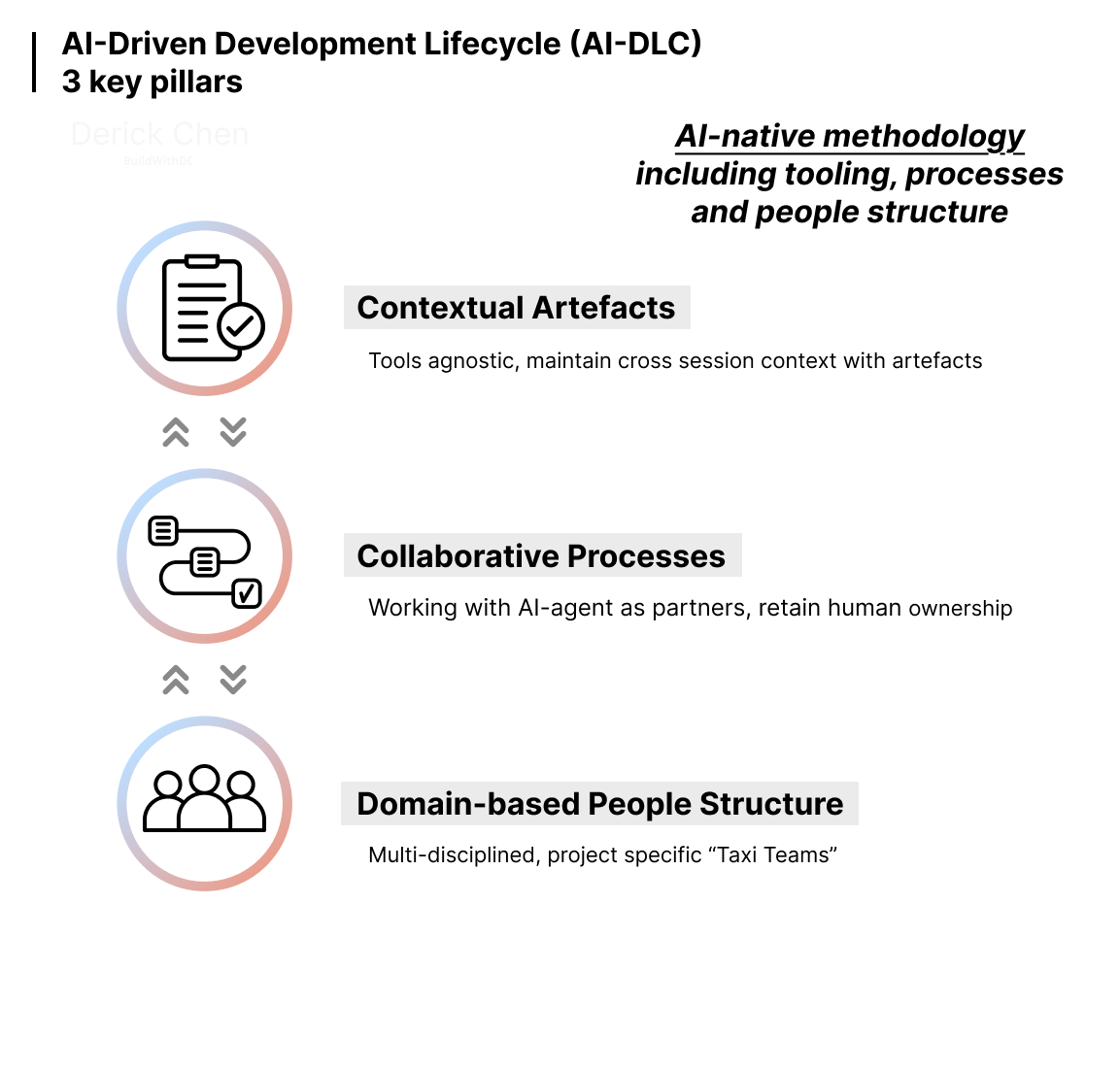
Within each step, teams follow a repeatable **Plan-Execute-Validate cycle **utilizing the incremental context constructed from previous phases and complete the following steps:
Planning: Teams collaborate with AI to elaborate the current step’s objectives into detailed specifications and implementation plans. AI works as a partner, asking clarification questions to gather more guidance and specific context from humans. AI provides comprehensive analysis, suggests optimal approaches, and identifies potential challenges before execution begins. This serves as the first human-in-the-loop verification point for early course correction to minimize repeated full scope asset reviews.
Execution: AI handles routine implementation tasks according to the approved plan, while humans focus on strategic trade-off decisions and quality validation. This partnership enables teams to maintain oversight and control while leveraging AI’s capability for rapid, consistent code generation and system integration.
Validation: Continuous review, verification, and feedback loops ensure quality throughout development rather than at the end. By validating that artefacts created in each AI-DLC iteration fulfill all business and technical requirements, teams minimize the risk of small mistakes or context gaps escalating into large, inaccurate implementations that are difficult to review and expansive to correct.
Now that we understand the high level processes and outcomes, in the next post, I will discuss more on how to put this into practices with a new team structure and activities. If you have any questions, leave a comment below and let’s have a discussion!