From Individual Technique to Team Methodology
The AI-assisted development landscape has rapidly evolved from simple code completion to sophisticated AI agents capable of generating entire applications. Yet many teams find themselves caught between two extremes: the chaos of “vibe coding” where developers prompt AI agents ad-hoc without structure (AI-Managed), and traditional development approaches that fail to leverage AI’s transformative potential (AI-Assisted).
Two approaches have emerged to address this challenge: the AI-Driven Development Lifecycle (AI-DLC), which we created in November 2024, and Spec-Driven Development (SDD), formalised more recently by Amazon’s Kiro team. While developed in different timeframes, both share core principles around using structured specifications to guide AI development.
AI-DLC represents a comprehensive methodology for team collaboration and organisational transformation, while spec-driven development provides the foundational technique that validates our approach to specification-based AI programming.
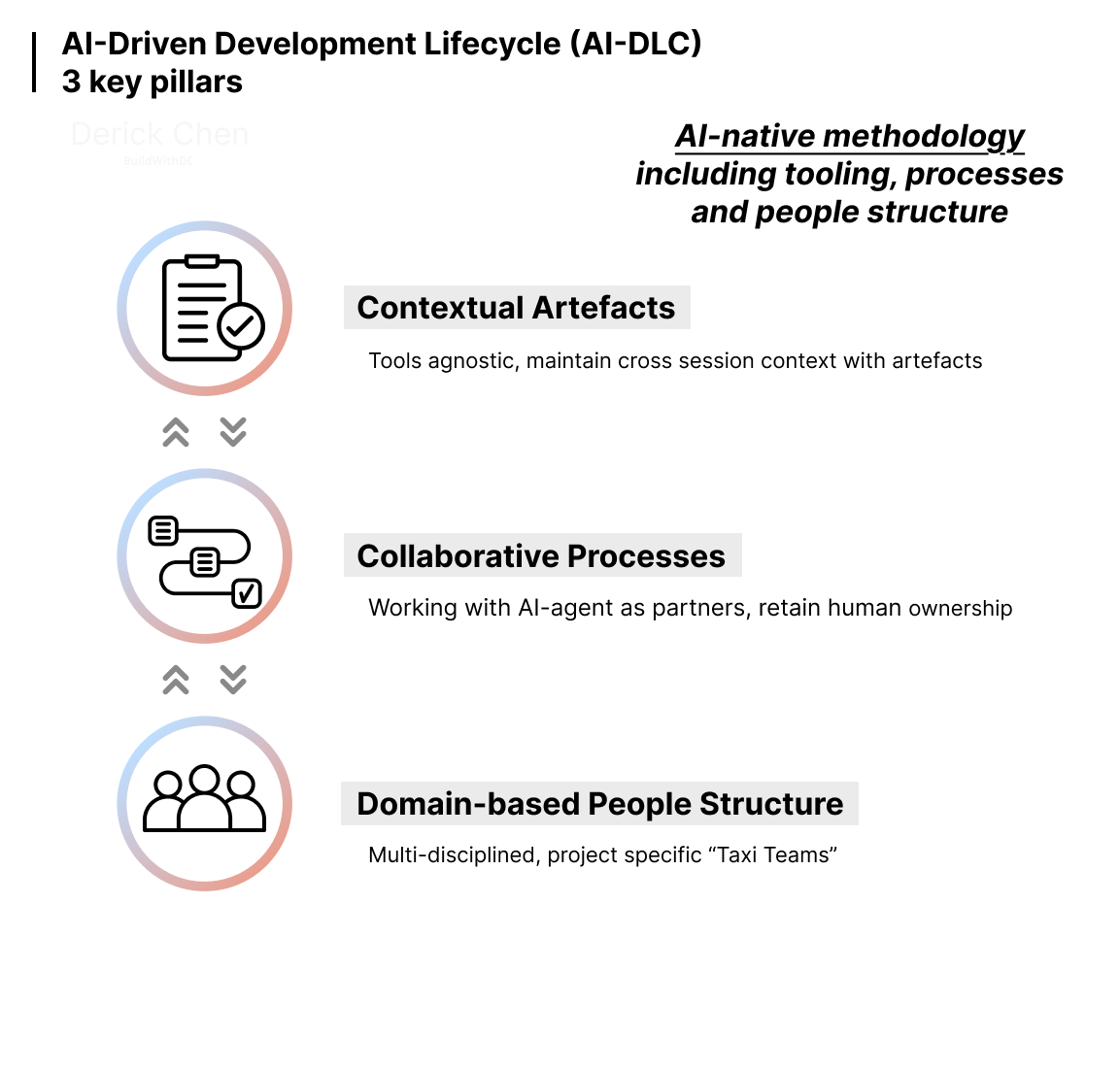
Spec-Driven Development: The Core Technique Link to heading
At the time of writing, Spec-Driven Development is still continuously being evolved. The definitions in this article are accurate as of November 2025.
Spec-driven development transforms AI-assisted programming from ad-hoc “vibe coding” to structured development using specifications as “super prompts.” These version-controlled documents serve as North Star guidance for AI agents, enabling them to handle larger tasks while maintaining focus on program objectives.
The technique operates through a simple workflow: specification → design → implementation. Developers create comprehensive specifications describing what programs should do, AI agents generate designs and code, and specifications provide authoritative validation references.
Two key characteristics define spec-driven development: individual developer focus (typically one person creating and maintaining specifications) and single artefact approach (one specification document serves as the central reference). While this solves the core technical challenge of AI-guided programming, it doesn’t address organisational challenges of team coordination and systematic adoption.
AI-DLC: Implementing SDD as Complete Methodology Link to heading
AI-DLC shares the foundational principles of spec-driven development and implements them within a systematic methodology designed for cross-functional teams and organisational transformation. Rather than replacing spec-driven development, AI-DLC operationalises the same core concepts through structured processes and team practices.
The three-phase AI-DLC structure (Inception, Construction, Operation) directly implements the specification workflow:
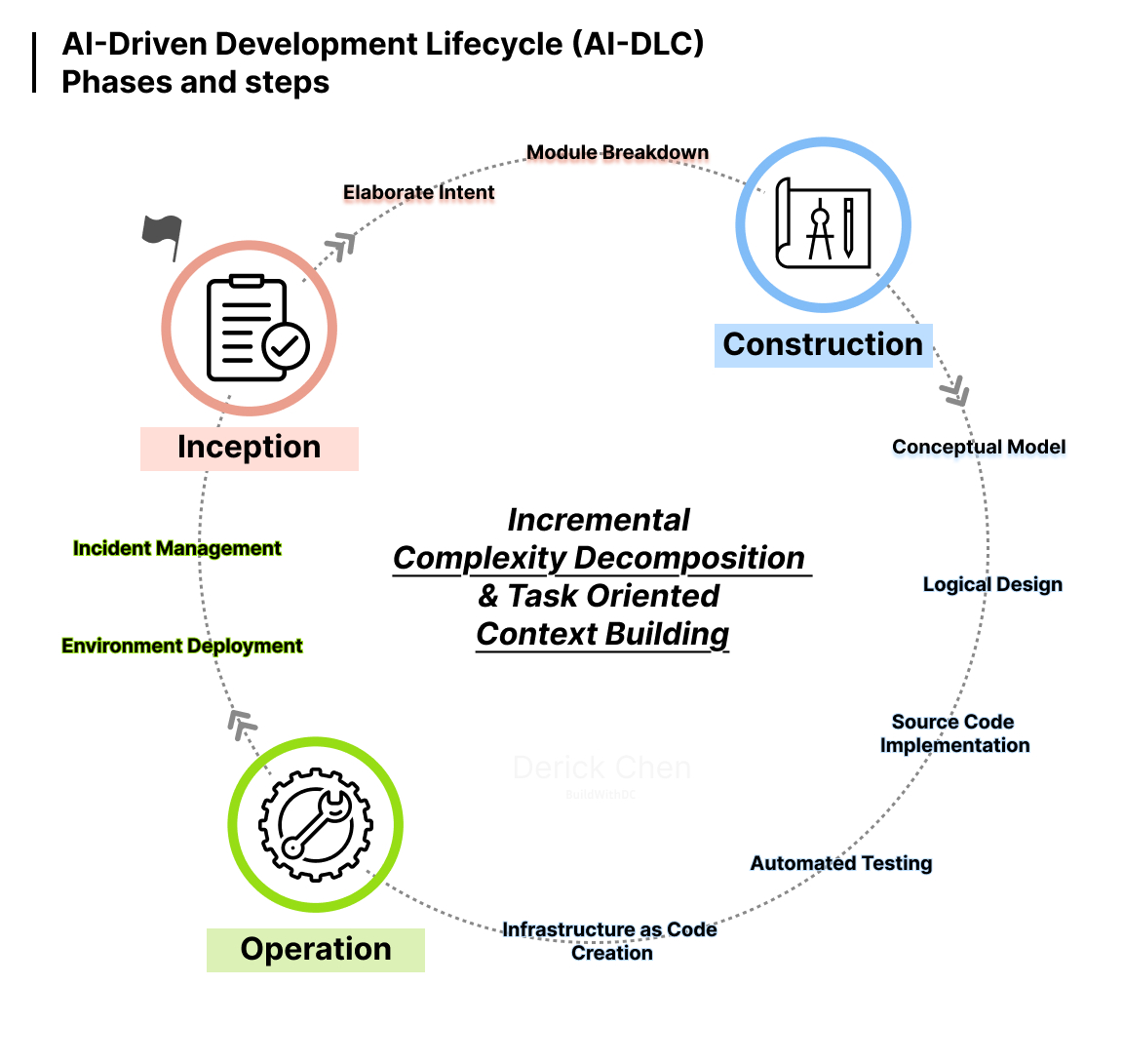 Inception Phase creates the specifications through collaborative requirements analysis. Teams work together to elaborate customer requirements into detailed user stories, and acceptance criteria—essentially creating the business level “super prompts” that will guide AI agents throughout development.
Construction Phase implements the design and development workflow from specifications and organisational best practices. Teams use the specifications created in Inception to guide conceptual modelling, logical design, and code generation, with AI agents generating implementation artefacts while humans maintain strategic oversight.
Operation Phase extends specification-driven principles to deployment and operations, using Infrastructure as Code and automated monitoring as specifications for system behaviour in production.
More details about the phases, steps and activities in AI-DLC.
The Plan-Execute-Validate cycle within each step directly implements the specification workflow at a granular level. Teams collaborate with AI to elaborate objectives into detailed, task oriented specifications (Plan), AI handles routine implementation according to approved plans (Execute), and teams validate outputs against requirements (Validate).
How AI-DLC Builds on SDD Foundations Link to heading
AI-DLC implements spec-driven principles through phase-specific artefacts that function as collaborative specifications: user stories define behavioural requirements, domain models capture business logic, and Infrastructure as Code templates specify operational behaviour. The mob ceremony structure systematises specification creation through cross-functional collaboration, while the three-phase framework enables iterative specification evolution rather than upfront perfection.
In a future article, I’ll explore in great detail how AI-DLC leverages advanced techniques (horizontal, vertical and work-stream specs) with adaptive specifications at different abstraction levels—from high-level business requirements in Inception to detailed technical specifications in Construction—with each phase optimising specification focus for its specific development objectives.
What AI-DLC Adds to Spec-Driven Development Link to heading
Team Structure and Collaboration Link to heading
SDD technique: Individual developers create and maintain specifications, working directly with AI agents. This approach works well for solo developers but doesn’t scale to cross-functional development or leverage diverse expertise.
AI-DLC methodology: Cross-functional “Taxi Teams” collaborate on specification creation through mob ceremonies. Business analysts, technical leads, and QA engineers contribute specialised knowledge in real-time, creating richer specifications while ensuring shared understanding.
Specification Architecture Link to heading
SDD technique: Single specification document serves as the central artefact, which can become unwieldy for large projects and create bottlenecks when multiple contributors are needed.
AI-DLC methodology: Phase-specific artefacts (user stories, domain models, logical designs) build incrementally, allowing different team members to contribute specialised knowledge while maintaining overall coherence through structured progression.
Process Framework Link to heading
SDD technique: Basic specification → implementation workflow provides the core pattern but lacks structure for complex projects with evolving requirements and multiple stakeholders.
AI-DLC methodology: Structured three-phase process with validation gates ensures specifications evolve systematically, stakeholders remain aligned as complexity increases, and organisational transformation is supported through defined roles and practices.
When SDD Technique Alone is Sufficient Link to heading
Spec-driven development as a standalone technique works well for:
Individual developers or very small teams where coordination overhead is minimal and a single person can effectively create and maintain specifications
Simple, well-defined projects with clear requirements that are unlikely to change significantly during development
Proof-of-concept or experimental development where the goal is to validate technical feasibility rather than build production systems
Organizations not ready for broader methodological change that want to experiment with AI-native development without restructuring teams or processes
When Full AI-DLC Methodology is Needed Link to heading
The complete AI-DLC methodology becomes essential for:
Cross-functional teams requiring coordination where business analysts, developers, architects, and QA engineers need to collaborate effectively
Complex projects with evolving requirements that benefit from iterative specification refinement and systematic validation
Organizations seeking systematic AI-native transformation that want to move beyond individual adoption to team-wide and organization-wide AI integration
Teams needing structured collaboration and knowledge sharing where the mob ceremony approach ensures all team members understand specifications and decisions
Projects requiring comprehensive quality validation and team alignment where the three-phase structure with validation gates prevents costly rework
Conclusion Link to heading
Spec-driven development provides the foundational technique for structured AI-guided programming, while AI-DLC implements these principles within a comprehensive methodology for team collaboration and organisational transformation.
The choice depends on context: individual developers and small teams can start with spec-driven development, while cross-functional teams and complex projects benefit from AI-DLC’s structured approach to collaborative specification creation.
Both approaches share the core insight that effective AI-native development requires moving from ad-hoc prompting to structured, version-controlled specifications that guide AI agents while preserving human strategic control. Spec-driven development provides the foundation; AI-DLC shows how to scale it organisationally.