Build complex software systems at scale
In a previous post, I discussed why both AI-Managed and AI-Assisted way of leveraging AI for production grade software development fall short of our expectations. AI-Managed does not work for complex, production grade software systems, while AI-Assisted still requires major human task breakdown and collaboration.
The answer to effectively utilizing AI to accelerate software delivery lies not just in a new approach, but an extended methodology that involves tools, processes and culture. We will start with the new approach that we call AI-Driven.
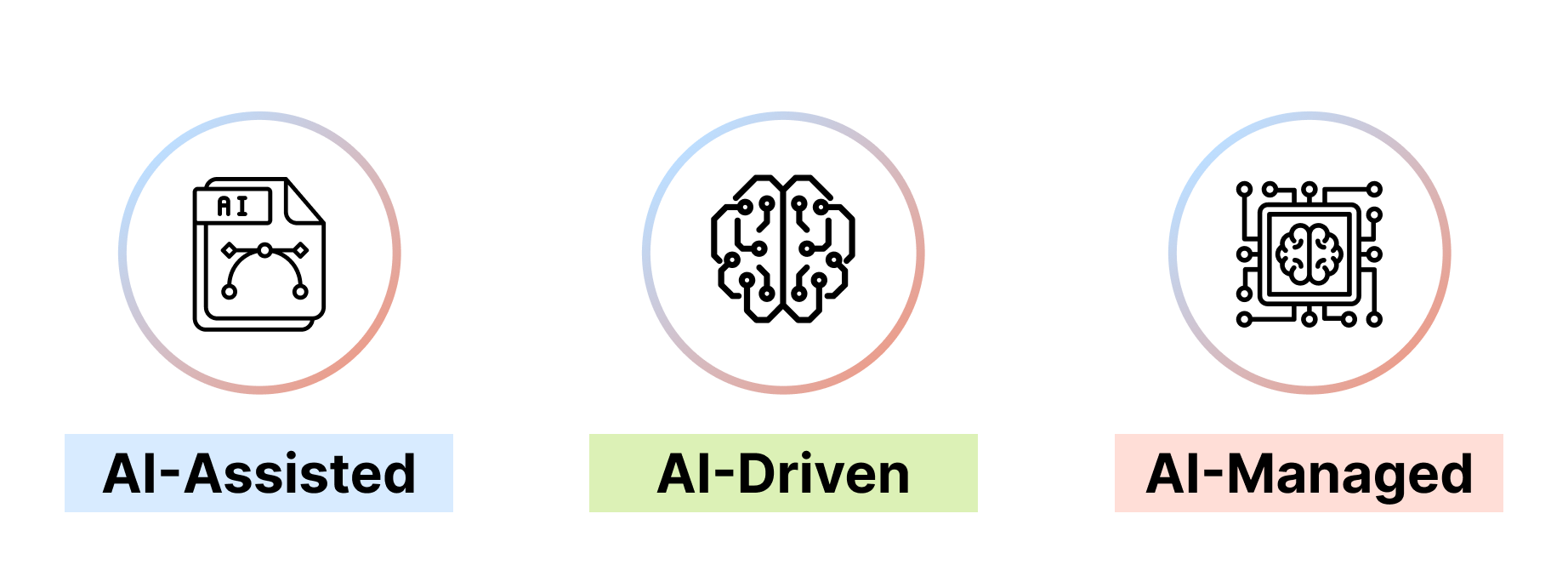
Quick recap Link to heading
AI-Managed - describe the high level business objectives and your AI coding companion will take care of the rest
High autonomy to the AI
Low/No human guidance
AI-Assisted - only delegate narrow tasks such as source code writing to the AI
Limited autonomy with well defined, narrow tasks for the AI
Extensive human guidance for task breakdown and integration
AI-Driven Link to heading
Now, AI-Driven is an approach that bridge the gaps of AI-Managed and AI-Assisted.
In AI-Driven, we maintain ownership, and exercise our human judgment and validate proposed solutions at each stage, while allowing AI to propose solutions and orchestrate the steps of the software delivery lifecycle.
Autonomy in proposing solutions and orchestration
Ask for proposals and drafts instead of implementing solutions
AI to clarify for critical decisions
Human guidance and critical decision making
Ask AI to plan and breakdown complex tasks for review before execution
Review artefacts generated at each stage of the workflow
Maintaining human ownership of assets generated by AI and exercising our judgment is a key differentiator for the AI-Driven approach. This enables us to have finer control in parts of the process if and when needed and delegate lower impact, easily reversible decisions to our AI agents.
There is a perfect point of balance that you must discover in your workflow - between the extreme levels of autonomy and human intervention. This depends on the foundational large language model (LLM) you choose and the style and quality of prompts you write.
But prompt engineering is not the point, it’s the mindset that is the game changer. The prompts you refine will become obsolete when a new LLM model is released that is trained different or a new AI tool is built with a different system prompt.
Prompts are a simple, dynamic variable in our optimization process, over-engineering this can only bring you to the local maximum. While understanding the importance of the AI-Driven approach shows you the path to the global maximum.
Comparison of Approaches Link to heading
Now, let’s see an example use case and how AI-Manage, AI-Driven and AI-Assisted approach differ from each other in the context of software engineering.
AI-Managed (High Autonomy, Low Human Involvement) Link to heading
Example: A developer specifies:
“Build me a web app that allows users to track their personal finances with login, dashboard, and monthly reports.”
The AI:
Designs the architecture,
Writes the backend and frontend code,
Sets up the CI/CD pipeline,
Deploys the app to a cloud platform,
And handles testing and monitoring.
The developer does little to no oversight beyond stating the goal.
AI-Assisted (Low Autonomy, High Human Involvement) Link to heading
Example: A developer manually:
Designs the system,
Breaks down tasks into functions,
Writes most code structure and logic.
Then asks the AI:
“Write a function to calculate monthly expenses from a list of transactions.”
The AI helps by:
Generating boilerplate or utility code,
Explaining regular expressions,
Providing suggestions during code editing.
Integration, orchestration, and validation are done entirely by the human.
AI-Driven (Balanced Autonomy, Collaborative) Link to heading
Example: A developer defines the business need:
“We need a personal finance tracker with user authentication and category-based spending insights.”
Then works collaboratively with AI by:
Letting AI propose system architecture and tech stack options, clarify important considerations
Reviewing and adjusting AI-generated plans,
Asking AI to scaffold services, generate code modules, write tests,
Validating outputs at each step and making only critical decisions on architecture, tradeoffs, and integrations,
Letting AI orchestrate build/deploy/test pipelines with human-validated checkpoints.
The human retains ownership, but leverages AI across the delivery lifecycle with strategic guidance.
But an approach alone is not enough for us to build complex systems even at a team level. The technology and approach help in siloed segments of the development process. We still need a robust and efficient way to collaborate between teams and scale the new way of building across an entire engineering organization. This is where we need to define a new AI-Driven Development Lifecycle.
To be continued.